🚚 Free Worldwide Shipping on All Orders!Shop Now
GAUDI COMPLETE WORKS
Rainer Zerbst
Hardback | 512 pages
Publication date 13 Sep 2020
The life of Antoni Gaudi (1852-1926) was full of complexity and contradictions. As a young man he joined the Catalonian nationalist movement and was critical of the church; toward the end of his life he devoted himself completely to the construction of one single spectacular church, La Sagrada Familia. In his youth, he courted a glamorous social life and the demeanor of a dandy. By the time of his death in a tram accident on the streets of Barcelona, his clothes were so shabby that passersby assumed he was a beggar.
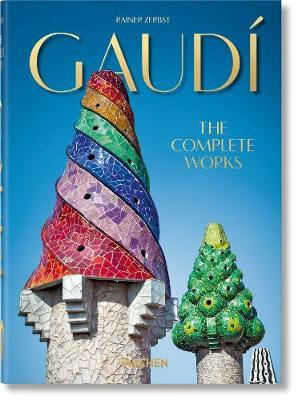
Gaudi's incomparable architecture channels much of this multifaceted intricacy. From the shimmering surface textures and skeletal forms of Casa Batllo to the Hispano-Arabic matrix of Casa Vicens, his work merged the influences of Orientalism, natural forms, new materials, and religious faith into a unique Modernista aesthetic. Today, his buildings enjoy global popularity and acclaim; his magnum opus, the Sagrada Familia, is the most-visited monument in Spain and seven of his works are UNESCO World Heritage Sites.
Hardback | 512 pages
Publication date 13 Sep 2020
The life of Antoni Gaudi (1852-1926) was full of complexity and contradictions. As a young man he joined the Catalonian nationalist movement and was critical of the church; toward the end of his life he devoted himself completely to the construction of one single spectacular church, La Sagrada Familia. In his youth, he courted a glamorous social life and the demeanor of a dandy. By the time of his death in a tram accident on the streets of Barcelona, his clothes were so shabby that passersby assumed he was a beggar.
Gaudi's incomparable architecture channels much of this multifaceted intricacy. From the shimmering surface textures and skeletal forms of Casa Batllo to the Hispano-Arabic matrix of Casa Vicens, his work merged the influences of Orientalism, natural forms, new materials, and religious faith into a unique Modernista aesthetic. Today, his buildings enjoy global popularity and acclaim; his magnum opus, the Sagrada Familia, is the most-visited monument in Spain and seven of his works are UNESCO World Heritage Sites.
$34.08
GAUDI COMPLETE WORKS—
$34.08
GAUDI COMPLETE WORKS
Rainer Zerbst
Hardback | 512 pages
Publication date 13 Sep 2020
The life of Antoni Gaudi (1852-1926) was full of complexity and contradictions. As a young man he joined the Catalonian nationalist movement and was critical of the church; toward the end of his life he devoted himself completely to the construction of one single spectacular church, La Sagrada Familia. In his youth, he courted a glamorous social life and the demeanor of a dandy. By the time of his death in a tram accident on the streets of Barcelona, his clothes were so shabby that passersby assumed he was a beggar.
Gaudi's incomparable architecture channels much of this multifaceted intricacy. From the shimmering surface textures and skeletal forms of Casa Batllo to the Hispano-Arabic matrix of Casa Vicens, his work merged the influences of Orientalism, natural forms, new materials, and religious faith into a unique Modernista aesthetic. Today, his buildings enjoy global popularity and acclaim; his magnum opus, the Sagrada Familia, is the most-visited monument in Spain and seven of his works are UNESCO World Heritage Sites.
Hardback | 512 pages
Publication date 13 Sep 2020
The life of Antoni Gaudi (1852-1926) was full of complexity and contradictions. As a young man he joined the Catalonian nationalist movement and was critical of the church; toward the end of his life he devoted himself completely to the construction of one single spectacular church, La Sagrada Familia. In his youth, he courted a glamorous social life and the demeanor of a dandy. By the time of his death in a tram accident on the streets of Barcelona, his clothes were so shabby that passersby assumed he was a beggar.
Gaudi's incomparable architecture channels much of this multifaceted intricacy. From the shimmering surface textures and skeletal forms of Casa Batllo to the Hispano-Arabic matrix of Casa Vicens, his work merged the influences of Orientalism, natural forms, new materials, and religious faith into a unique Modernista aesthetic. Today, his buildings enjoy global popularity and acclaim; his magnum opus, the Sagrada Familia, is the most-visited monument in Spain and seven of his works are UNESCO World Heritage Sites.
Product Information
Product Information
Shipping & Returns
Shipping & Returns
Description
Rainer Zerbst
Hardback | 512 pages
Publication date 13 Sep 2020
The life of Antoni Gaudi (1852-1926) was full of complexity and contradictions. As a young man he joined the Catalonian nationalist movement and was critical of the church; toward the end of his life he devoted himself completely to the construction of one single spectacular church, La Sagrada Familia. In his youth, he courted a glamorous social life and the demeanor of a dandy. By the time of his death in a tram accident on the streets of Barcelona, his clothes were so shabby that passersby assumed he was a beggar.
Gaudi's incomparable architecture channels much of this multifaceted intricacy. From the shimmering surface textures and skeletal forms of Casa Batllo to the Hispano-Arabic matrix of Casa Vicens, his work merged the influences of Orientalism, natural forms, new materials, and religious faith into a unique Modernista aesthetic. Today, his buildings enjoy global popularity and acclaim; his magnum opus, the Sagrada Familia, is the most-visited monument in Spain and seven of his works are UNESCO World Heritage Sites.
Hardback | 512 pages
Publication date 13 Sep 2020
The life of Antoni Gaudi (1852-1926) was full of complexity and contradictions. As a young man he joined the Catalonian nationalist movement and was critical of the church; toward the end of his life he devoted himself completely to the construction of one single spectacular church, La Sagrada Familia. In his youth, he courted a glamorous social life and the demeanor of a dandy. By the time of his death in a tram accident on the streets of Barcelona, his clothes were so shabby that passersby assumed he was a beggar.
Gaudi's incomparable architecture channels much of this multifaceted intricacy. From the shimmering surface textures and skeletal forms of Casa Batllo to the Hispano-Arabic matrix of Casa Vicens, his work merged the influences of Orientalism, natural forms, new materials, and religious faith into a unique Modernista aesthetic. Today, his buildings enjoy global popularity and acclaim; his magnum opus, the Sagrada Familia, is the most-visited monument in Spain and seven of his works are UNESCO World Heritage Sites.